 Minority Rights Dominica seeks to represent people in the Dominican Community, who due to their natural orientation are denied their human rights.
Human Rights in Dominica
Human rights are universal. Every person is equally entitled to benefit from these rights, regardless of their race, religion, language, nationality, sex, gender, sexual orientation, disability, ethnic origin, or any other status. Every person is born with human rights. We have these rights simply by virtue of being human beings — they are not granted by the state.
All people have human rights and all people are equal. Equality goes hand in hand with the principle of non-discrimination. Discrimination means to treat people differently from others, in an unfair manner, based on certain protected personal characteristics. This can include a person’s race, religion, gender, age, or sexual orientation, among other things.
States have obligations under international law to respect, protect, and fulfill the human rights of their citizens. This means:
- The state must not violate or interfere with a person’s human rights.
- The state must protect individuals from having their human rights abused by others.
- The state must take positive actions to help individuals enjoy their basic human rights.
In Dominica, human rights are found in the Constitution. The Constitution is the core legal document that sets out the fundamental principles and ideals of the Dominican state. How constitutional principles are interpreted and applied can change over time as the attitudes and beliefs of Dominican society evolve.
The Constitution of Dominica protects many human rights, including:
- The right to life (section 2);
- The right to personal liberty (section 3);
- Protection from inhuman treatment (section 5);
- Protection from arbitrary search or entry (section 7).
In democracies like Dominica, courts and judges have an important role to play in interpreting laws and in making sure that laws do not violate the Constitution.
The Constitution is the supreme law of the country. If a law goes against the Constitution, judges can decide that the law must be changed or overturned. If a judge decides that a law is unconstitutional, that will mean that the law is invalid and it will no longer apply. Dominican citizens can apply to the courts to challenge a law if they think that it goes against the Constitution or if they feel that their human rights are being violated by the government.
Download the 2026 Baseline study on LGBTQAI+ needs in Dominica:
Download our pamphlet- Human Rights of LGBTQ+ People in Dominica – for more information:
Our Position as of July 2025.
Download the Step Up! So other’s don’t get stepped ON bookmark:
The Current Status of LGBTQ+ Rights in Dominica
As a result of a legal judgement in April 2024, people in Dominica over the age of 16 no longer face the risk of being arrested, prosecuted, or convicted for having consensual same-sex sexual relations in private. The legal challenge did not have anything to do with same-sex unions or marriages. Same-sex unions and marriages are not legal in Dominica at this time. Please read our statement from the time of the court decision here.
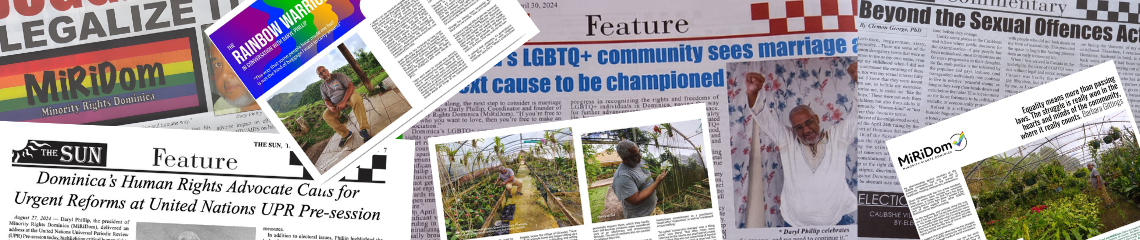
In the Media
- DOMINICA: ‘It’s an ongoing journey to achieve full inclusion and acceptance of LGBTQI+ people’
- MiRiDom celebrates and welcomes court ruling
- Progress in the Caribbean as Dominica Decriminalizes Same-Sex Relations
- MiRiDom has released its recommendations to the Government of Dominica requesting Policy Change for equal rights for the LGBTQI Community and Electoral Reform
- MiRiDom Welcomes High Court Ruling Declaring Buggery Laws in Dominica Unconstitutional