 Today, on the International Day Against Homophobia, Transphobia, and Biphobia (IDAHOBIT), we are reflecting on our legacy amongst activists working “at the heart of democracy” (the 2026 IDAHOBIT theme) to fight the bigotry that fueled — and continues to fuel — the HIV epidemic.
In the very early days of the epidemic, first officially reported 45 years ago next month, what we now know as HIV and AIDS were being called Gay-Related Immune Deficiency (GRID) because of the sexual orientation of people who had acquired the virus. In the following years, rather than act immediately to end transmission and develop treatments for the deadly virus, governments sat still. Policies rooted in homophobia, whorephobia, and racism, alongside the so-called “War on Drugs,” allowed AIDS to take the lives of thousands of gay men, racialized people, people who use drugs, and sex workers, among many more.
It took massive community mobilization in the 1980s to push governments to invest in medical research and community-based supports for people living with HIV or AIDS. These investments not only resulted in the innovative community-based AIDS Service Organization model seen throughout Canada and the United States, but also allowed for the development of antiretroviral treatments, first made available in 1995. In the subsequent 30 years, HIV experts learned that antiretrovirals not only slowed the progression of HIV, but could also reduce the virus to non-detectable levels and remove the possibility of transmission.
We should have been able to fully end the transmission of HIV worldwide by 2026. But structural barriers — including those reflected in law and policy — persist, including criminalization, underfunding, stigma, racism, and the lingering impacts of colonialism.
In Canada, the criminalization of HIV non-disclosure — which can see people living with HIV charged with aggravated sexual assault for allegedly not disclosing their HIV status to a sexual partner, even when there is no possibility of HIV transmission and indeed transmission did not occur — continues to disproportionately persecute members of 2SLGBTQIA+ and Black and Indigenous communities, among other groups. Despite repeated promises by the Government of Canada to reform these laws, they are still on the books. With the advent of the first federal majority government since 2019, we now have a critical window to address these punitive and unscientific laws that put Canada out of step with our human rights obligations, and we will push policymakers until the law reflects both human rights values and the scientific consensus.
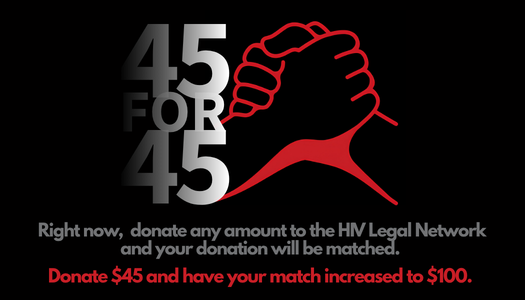
We are prepared to use this opportunity to dive even further into the heart of democracy, but we can’t do it without you. The values that we share with our generous supporters are key to the work that we do, and will guide us as we face the challenges posed by funding cuts, political opportunism, and human rights rollbacks. In honour of IDAHOBIT, we have chosen today to launch our #45for45 campaign.
Right now, anybody who donates any amount to the HIV Legal Network will have their donation matched. In recognition and remembrance of the 45 years of this epidemic, those who donate $45 will have their donation not only be matched but increased to $100. Thinking about becoming a monthly donor? Your donation will be matched each and every month.
This International Day Against Homophobia, Transphobia, and Biphobia, please consider joining the fight for human rights and dignity for all by donating to the HIV Legal Network. We can’t do it without you, and time is of the essence.
In Solidarity
The HIV Legal Network