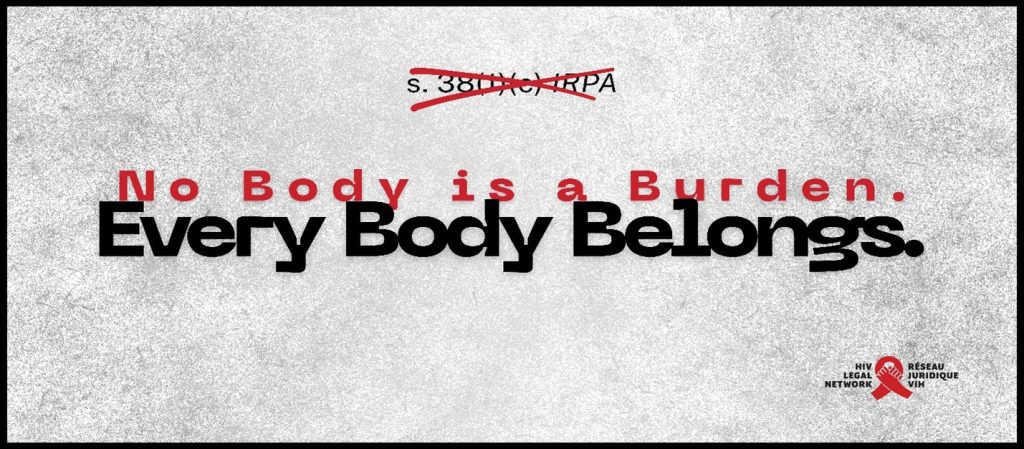
Across Canada, people with disabilities and chronic health conditions are being told they are “too costly” to belong. Section 38(1)(c) of the Immigration and Refugee Protection Act (IRPA) reduces people to projected expenses, ignoring their lives, relationships, and contributions. The rule reinforces stigma and exclusion – and it has no place in an inclusive immigration system. No body is a burden. Every body belongs.
“I don’t think I could have been happy in Canada after going through that whole process because it shattered my dream of Canada. It led me to realize that the picture Canada posts to the rest of the world is not the reality of Canada today.” – Clifford Perreira speaking about being processed under s. 38(1)(c) (Centre for Refugee Studies seminar, November 26, 2025)
“Excessive demand” in a nutshell
Under s. 38(1)(c) of IRPA, a person can be denied entry or residence in Canada if they – or a family member – are expected to place an “excessive demand” on publicly fnuded health or social services. Each year, Immigration, Refugees, and Citizenship Canada (IRCC) sets a dollar threshold to define what counts as “excessive demand.” If an applicant’s projected costs exceed this threshold, they and their family members are deemed “medically inadmissible” (see IRCC – Medical Inadmissibility).
Why “excessive demand” must end
The “excessive demand” rule is built on assumptions that have no place in a modern, rights-respecting immigration system. The rule treats disability and chronic health conditions as liabilities, rather than as part of the diversity of human experience. There is no evidence that the rule meaningfully reduces costs – but there is abundant evidence that it causes harm.
- It reinforces stigma and exclusion. By reducing people to the projected cost of their care, the law echoes outdated beliefs that people with disabilities or chronic conditions are burdens. It perpetuates stigma, particularly against people living with HIV, and forces applicants to defend their worthiness to belong.
- It fails to achieve its stated purpose. IRCC has acknowledged that it lacks reliable data to estimate actual costs or savings. The data that IRCC does have suggests that the provision produces, at most, negligible savings – while imposing burdens on applicants, provinces, and IRCC itself.
- It disrupts lives and separates families. People are denied education and work opportunities, permanent residence, and family reunification because of speculative estimates about future care needs. Many abandon their applications entirely because of the time, cost, and complexity required to prove they are “not a burden.”
- It is out of step with Canada’s human rights commitments. United Nations bodies have repeatedly called on Canada to repeal the provision. A law that discriminates by design – and produces no meaningful benefit – cannot be justified.
Resources
HIV Legal Network
- Immigration and Travel to Canada for People Living with HIV – Questions and Answers (October 16, 2023)
- Challenging the constitutionality of Canada’s “excessive demand” regime in Federal Court (April 17, 2024)
- Returning to the Federal Court in constitutional challenge of Canada’s “excessive demand’ regime (September 12, 2025)
- Statement on the Federal Court’s Decision Regarding Public Interest Standing in the Medical Inadmissibility Challenge (November 27, 2025)
United Nations
- Concluding observations on the combined second and third periodic reports of Canada (April 15, 2025) – Recommending the repeal of s. 38(1)(c) IRPA
- Grainne Sherlock v Australia (March 19, 2021) – Confirming the rights violations of Australia’s own ‘medical inadmissibility’ provisions
Government of Canada
- Building an Inclusive Canada: Bringing the Immigration and Refugee Protection Act in Step with Modern Values (December 2017) – Recommending the repeal of s. 38(1)(c) IRPA
- Government of Canada brings medical inadmissibility policy in line with inclusivity for persons with disabilities (April 18, 2018) – Federal government agreeing to repeal s. 38(1)(c) IRPA
In the News
- HIV-positive student fighting Canada’s admissibility rules (June 3, 2024)
- An HIV advocate says federal ministry of immigration needs to change what’s known as the ‘excessive demand’ provision (April 30, 2024)
Other
- ‘Bad’ Bodies, Borders and Un-Belonging: Conversations about Medical Inadmissibility (November 26, 2025) – Seminar hosted by Centre for Refugee Studies
- It’s time to repeal s. 38(1)(c) – Campaign by University of Toronto HLTD06 H3 Fall Class of 2025